




Need a reliable way to validate WooCommerce event tickets and prevent duplicate entry at the gate? Choose a QR scanner that connects ticket generation, delivery, validation, status updates, and staff access in one tested workflow. The questions below will help you select and prepare the right solution for your event.
Why the scanner matters in a WooCommerce QR ticketing workflow
The scanner determines whether staff can admit each guest quickly and confidently. It must do more than recognize an event ticket QR code: it should verify the associated ticket record, show a clear result, and update its status after admission.
This is the point where your online sales process meets the physical event. Slow scans, ambiguous messages, or outdated ticket statuses can create queues even when ticket sales and delivery work correctly.
If you are still planning the broader sales process, review how to build a WordPress ticketing system using WooCommerce. The complete customer journey should cover purchase, ticket generation, delivery, presentation at the venue, validation, and the final status update.
What must the scanner integrate with?
The scanner must integrate with the system that creates the ticket, stores its unique code, and records whether it has been used. In a WooCommerce workflow, all these components should refer to the same ticket or coupon record.
Flexible PDF Coupons PRO – Event Ticket QR Scanner works as an add-on to Flexible PDF Coupons PRO for WooCommerce. The core plugin creates and delivers PDF coupons, while the scanner add-on adds event ticket QR code generation, camera scanning, manual verification, and ticket status management.
The Event Ticket QR Scanner documentation explains how to configure and use this workflow. You can also review Flexible PDF Coupons PRO – Event Ticket QR Scanner before deployment.
After a successful scan, Event Ticket QR Scanner changes the coupon status in WooCommerce. Because subsequent checks use the current coupon record, staff can distinguish an unused ticket from one that has already been admitted.
Before configuration, map the complete process:
- Determine when WooCommerce generates the ticket.
- Confirm how the customer receives the PDF or ticket link.
- Check that the QR code identifies the correct coupon record.
- Define which coupon statuses permit or block admission.
- Decide which staff members can scan tickets and change statuses.
- Confirm how records will be reviewed after the event.
Which devices will your check-in team use?
Event Ticket QR Scanner can use the camera on a phone, tablet, computer, or another compatible device. The best device is one that your staff can handle comfortably and that focuses quickly under the conditions expected at the entrance.
Camera access requires the scanner page to run through HTTPS or localhost. Test access on the live event website because browser permissions, security settings, and camera behavior can differ from a development environment.
Prepare a list of the device models, operating systems, browsers, and cameras that will be used. Older phones may focus more slowly, tablets may be awkward in crowded entrances, and laptops are generally better suited to fixed reception desks.
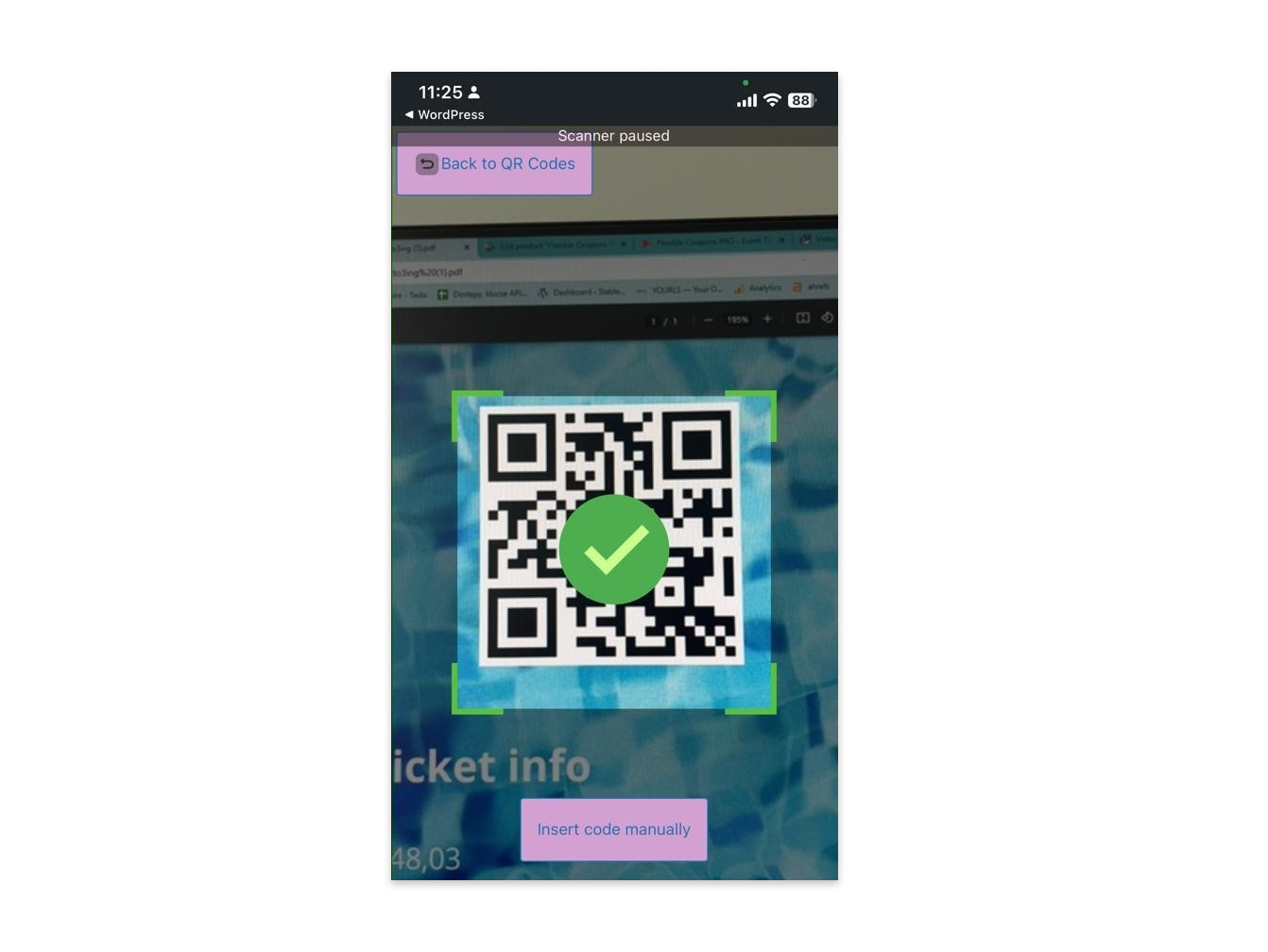
The interface should remain readable on every planned screen size. Staff should be able to see validation results, use manual verification, and start the next scan without zooming or precisely tapping small controls.
The following screenshot shows the camera-based scanning and verification interface:
For more information about introducing this functionality, see how to add a QR Code reader for WooCommerce.
Will the scanner work under your venue conditions?
The scanner should be tested at the venue or in a realistic recreation of its lighting, connectivity, and entry setup. A successful office test does not prove that the same device will scan reliably at an outdoor gate or inside a dark concert hall.
Test printed tickets, original PDFs, screenshots, and codes displayed inside email applications. Include phones with low screen brightness, reflective displays, damaged printouts, folded pages, and different QR code sizes.
Your venue test should answer these practical questions:
- Does the camera focus quickly in low or uneven light?
- Can it read QR codes from both paper and phone screens?
- Does glare interfere with scanning at outdoor entrances?
- Can staff adjust lighting without delaying the queue?
- Do protective device cases obstruct the camera?
- Is Wi-Fi or mobile data available at every entry point?
Event Ticket QR Scanner validates tickets against WooCommerce records, so every scanning device should have a stable connection to the website. Prepare a backup internet connection instead of relying on unverified offline operation.
How many tickets and entry points must it handle?
Plan capacity around peak arrivals, not only the total number of tickets sold. Estimate how many guests may reach the entrances during the busiest 10- or 20-minute period, then provide enough devices and trained operators for that volume.
An event with 1,000 guests arriving over several hours has different requirements from one where most attendees arrive immediately before a scheduled performance. Exceptions such as unreadable, refunded, or previously used tickets also take longer than standard admissions.
Include the following factors in your capacity estimate:
- Total paid and complimentary tickets.
- Expected arrivals during the busiest interval.
- Number of entrances and priority queues.
- Average time required for a successful scan.
- Average time required to resolve an exception.
- Number of trained staff members and spare devices.
- Network quality at every scanning position.
Run several scanners simultaneously during testing. If multiple entrances validate tickets against the same WooCommerce records, this rehearsal will show whether status changes are visible quickly enough across all devices.
How should each event ticket QR code be validated?
Each scan should check the current WooCommerce coupon record, not merely confirm that the QR code can be decoded. Staff need to know whether the ticket is available for admission, already used, expired, cancelled, refunded, or unrelated to the event.
Flexible PDF Coupons PRO – Event Ticket QR Scanner uses WooCommerce coupon records and displays ticket status information based on coupon usage. It supports camera scanning, manual code entry, and administrative status changes available to authorized users.
Define the required staff action for every possible result. A valid unused ticket can be admitted immediately, while a used ticket may require identity verification or escalation. A refunded ticket should not be handled in the same way as an unreadable QR code.
If a ticket permits more than one use, make sure the permitted usage and remaining admissions match your event rules. Test these cases before selling tickets rather than first encountering them at the entrance.
Can the workflow prevent duplicate or invalid entries?
Yes. After a successful scan, Event Ticket QR Scanner updates the associated coupon status in WooCommerce. If the same ticket is presented again, staff can see that its record has already been used instead of treating the code as a new admission.
Test this behavior with at least two devices. Scan a ticket at one entrance, then immediately present the same ticket at another. The second operator should receive a clear result based on the updated WooCommerce record.
Also test random QR codes, codes from another event, expired coupons, refunded orders, and tickets that have reached their usage limit. Recognizing a QR image is not enough; the associated record must satisfy the event’s admission rules.
The following coupon-management screen shows ticket status information alongside usage and expiry data:
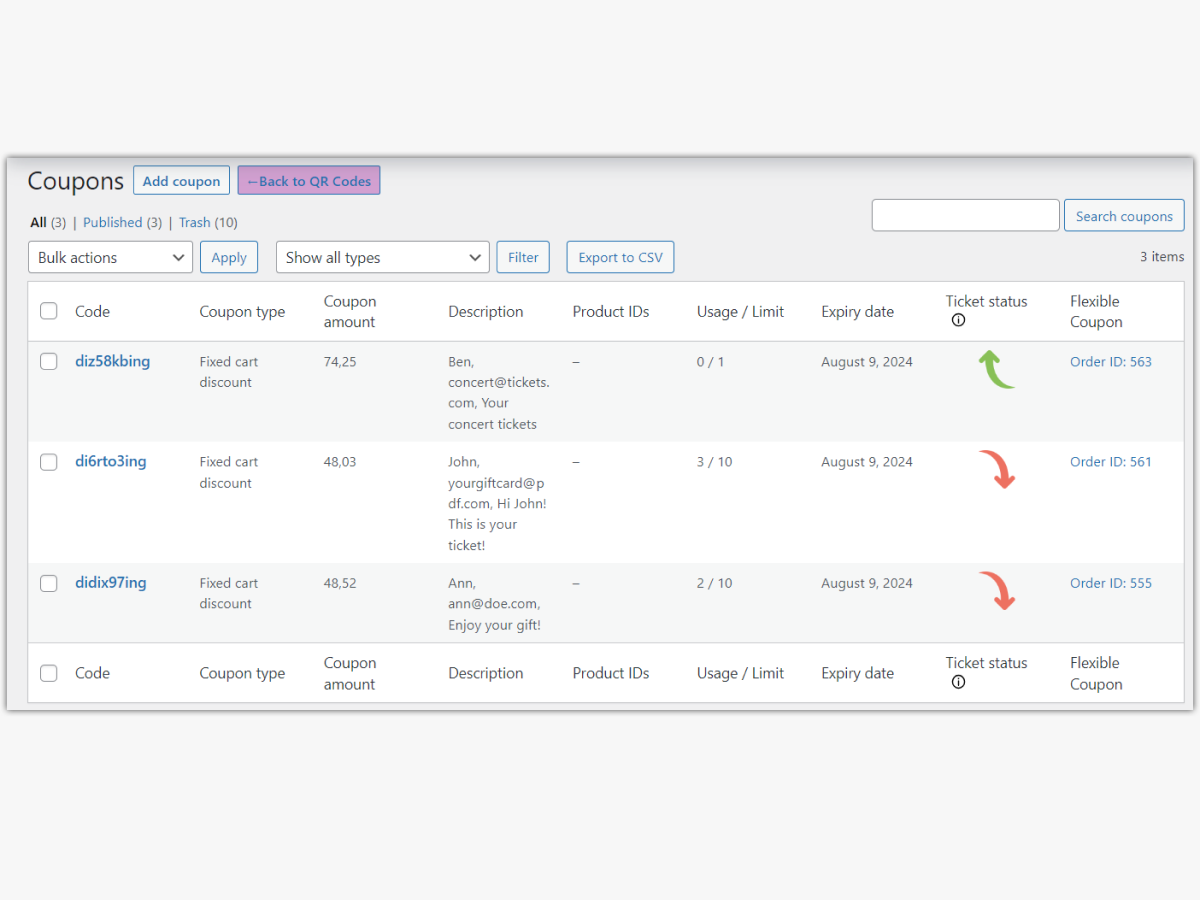
The official coupon management documentation explains the information available in the WooCommerce coupon list.
What should staff see after scanning a ticket?
Staff should immediately see an unambiguous validation result and the information needed to decide whether to admit the guest. The message should use clear text rather than relying only on color.
This is especially important in bright sunlight, on small displays, and for staff with color-vision differences. Operators should be able to distinguish a valid ticket from a used, expired, invalid, or unreadable one without interpreting technical data.
Display only information required for check-in. Depending on your workflow, this may include the ticket code, event or product name, coupon status, usage count, and expiry date. Staff accounts should not receive broader access to orders or customer data unless their role requires it.
How easy is it to train and manage the check-in team?
The workflow is suitable for front-line staff when each person has the correct account, role, camera permission, and exception procedure. Training should include both normal scanning and the steps required when a ticket cannot be admitted immediately.
Flexible PDF Coupons PRO – Event Ticket QR Scanner adds an Event Manager role. This role provides permissions for viewing relevant WooCommerce coupons, scanning ticket QR codes, and changing coupon statuses without requiring every operator to be a full WordPress administrator.
Each operator should practise how to:
- Sign in and open the scanning interface.
- Grant browser access to the device camera.
- Position paper and digital QR codes correctly.
- Interpret each ticket status.
- Use manual code verification when scanning fails.
- Escalate refunded, disputed, or duplicate tickets.
Assign one experienced supervisor to handle exceptions while front-line operators continue processing standard admissions. Remove temporary staff access after the event if those users no longer need it.
What is the fallback plan for connectivity or device failure?
Your fallback plan should include spare devices, backup internet access, manual code verification, and a controlled escalation process. No entrance should depend on one phone, charger, network connection, or staff account.
Use the following response order when a scan fails:
- Clean the camera lens and increase the brightness of the guest’s screen.
- Retry the scan with the QR code held flat and steady.
- Enter the ticket code manually if the QR image remains unreadable.
- Move the operator to a charged, previously tested spare device.
- Switch to an approved backup internet connection.
- Escalate uncertain, refunded, or duplicate records to a supervisor.
- Record any exceptional manual admission for later reconciliation.
Prepare power banks, charging cables, secure login details, and written instructions before opening the doors. If you maintain a backup attendee list, restrict access and avoid exposing customer information that is not needed for admission.
How should you test the complete workflow before the event?
Test the process from WooCommerce order placement to the final ticket status update. Use the same payment scenarios, ticket formats, devices, browsers, user roles, and entry conditions planned for the event.
A complete rehearsal should include these stages:
- Place test orders using the relevant payment and order statuses.
- Confirm that the expected tickets are generated and delivered.
- Open tickets from emails, PDF files, screenshots, and printed pages.
- Scan valid tickets with every planned device and browser.
- Scan the same ticket again to verify duplicate-entry handling.
- Test expired, refunded, unrelated, and malformed codes.
- Use manual verification for an unreadable QR code.
- Operate several scanners simultaneously.
- Switch devices and networks to rehearse the fallback plan.
- Review the resulting coupon statuses in WooCommerce.
Record the outcome of each scenario and correct any issue before launch. When assessing a competing scanner, ask its provider to demonstrate any capability that is not clearly documented.
For more examples of where this workflow can be used, read about the benefits of QR code ticketing for events.
Downloadable event ticket QR scanner checklist
Use the downloadable checklist during configuration, venue testing, and the final event rehearsal:
Download the WooCommerce event ticket QR scanner checklist
Summary
The right scanner connects WooCommerce ticket generation with clear, current admission decisions. Flexible PDF Coupons PRO – Event Ticket QR Scanner reads ticket QR codes, supports manual verification, displays coupon status information, and updates the WooCommerce coupon record after a successful scan.
Test the complete workflow with real devices, realistic ticket formats, multiple operators, and venue-like conditions. A short rehearsal and a prepared fallback plan can prevent long queues, duplicate admissions, and uncertain decisions when guests arrive.
FAQ
Does Event Ticket QR Scanner update a ticket after admission?
Yes. After a successful scan, Event Ticket QR Scanner changes the associated coupon status in WooCommerce. This allows subsequent scans to identify that the ticket has already been used.
Can staff scan tickets with a smartphone?
Yes. Staff can use a compatible phone, tablet, computer, or another camera-equipped device. The scanner page must run through HTTPS, and the browser must have permission to access the camera.
Can the scanner read printed and digital tickets?
It can scan QR codes presented on paper or a compatible digital display. Results depend on camera focus, lighting, print quality, screen brightness, glare, and QR code condition, so both formats should be tested before the event.
What happens if a QR code cannot be scanned?
Staff can use manual code verification when the ticket code is available. Your fallback procedure should also include a spare device, backup connectivity, and escalation to a supervisor for unresolved records.
How does the scanner help prevent duplicate admission?
The scanner validates the ticket against its WooCommerce coupon record and updates the status after successful admission. When the same ticket is presented again, staff can see that it has already been used.
Do staff need administrator access to WordPress?
No. The scanner add-on creates an Event Manager role with permissions related to viewing coupons, scanning QR codes, and changing coupon statuses. This avoids giving every check-in operator full administrator access.
Does the scanner require an internet connection?
The scanner works with ticket records stored in WooCommerce, so scanning devices should have a stable connection to the website. Prepare backup Wi-Fi or mobile data rather than depending on unverified offline validation.
Which plugin is required for the scanner add-on?
Flexible PDF Coupons PRO – Event Ticket QR Scanner requires Flexible PDF Coupons PRO for WooCommerce. The core plugin manages PDF coupon generation and delivery, while the add-on provides the event ticket QR scanning workflow.
